
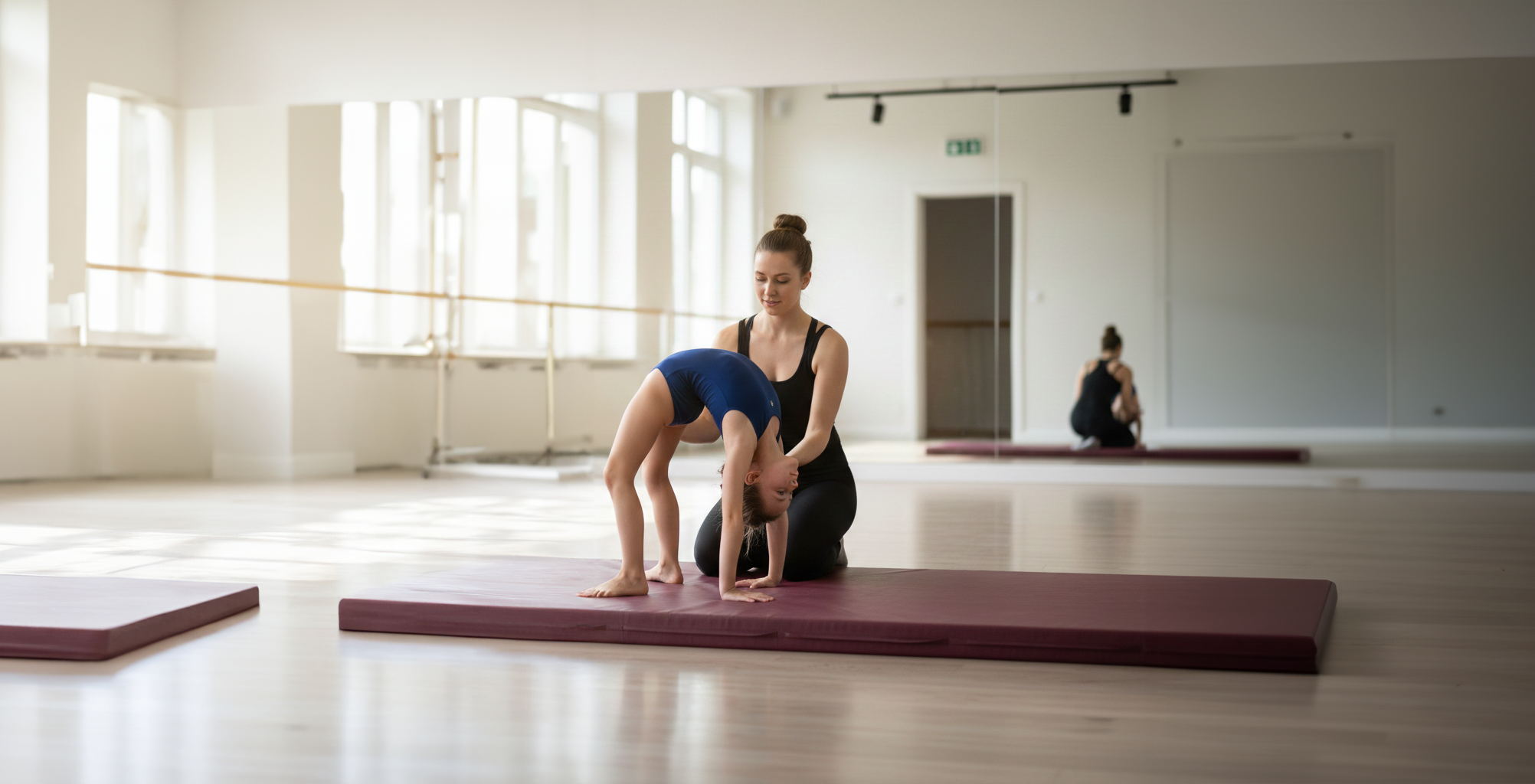
Acro vs Gymnastics, A Safety Focused Guide for Parents
If your child spends half their life upside down, you have probably wondered whether they should train properly, and which path is safer and more sustainable. This guide breaks down the real differences between acro dance and gymnastics, with a clear focus on surfaces, injury risk, long term body health, and quality of coaching.
Flooring, mat use, progressions and repetition volume shape injury risk.
Joint loading, growth plates, spinal management and burnout matter.
A structured syllabus, spotting, conditioning and qualified teaching.
You are sitting in your living room with a cup of tea when a pair of feet suddenly flashes past your line of sight. Your child has just attempted their fourteenth cartwheel of the afternoon, narrowly missing the coffee table, landing with a heavy thud on the carpet, then popping up with a massive grin.
As a parent, you likely feel a familiar mix of pride and immediate anxiety. You wonder if they are going to hurt themselves. You wonder if they need proper training. Most importantly, you ask yourself if this is safe.
The training surface and the way skills are progressed often matters more than the trick itself.
A growing body needs smart loading, not endless impact for the sake of it.
Coaching quality decides whether training builds confidence or builds injury risk.
If your child spends half their life upside down, you have probably considered enrolling them in a class to harness that incredible energy. This usually leads parents to a common crossroads, gymnastics or acro dance?
Both disciplines involve tumbling, strength, and flexibility. However, the philosophies, training methods, and long term impacts on a child's body can be very different. This guide is designed to give you an honest, expert look at the differences, so you can make an informed decision.
What is Acro Dance?
Acro dance is a highly athletic art form that blends classical dance technique with acrobatic elements. It is not simply about performing a trick in isolation. It is about how a dancer enters and exits that trick with fluidity, control, grace, and musicality.
In an acro programme, a child learns to control their body through space while maintaining the aesthetic lines of ballet, jazz, or contemporary dance. When an acro dancer performs a cartwheel or a walkover, the movement is integrated directly into a choreographed routine.
Strong acro teaching does not rush children into advanced tumbling. Students spend significant time on conditioning, flexibility, and foundational drills before attempting higher level skills.
Acro focuses heavily on lengthening the body and maintaining strong alignment. The goal is to make gravity defying movements appear effortless, while still landing quietly and transitioning back into dance.
What is Gymnastics?
Gymnastics is a globally recognised sport governed by strict execution rules and point systems. It is a powerful discipline, but the core objective is different to acro dance. Gymnastics focuses on power, speed, and precise execution of connected skills in a competitive environment.
Gymnasts train across specific apparatuses. For girls this typically includes vault, uneven bars, balance beam, and floor. While floor routines use music, the focus remains on powerful tumbling passes, a series of connected, high impact skills performed with maximum force and height.
Because the sport is competitive by nature, training intensity can become demanding. Even at recreational level, children can train for multiple hours a week, and competitive squads may train significantly more.
Safety Comparison, Mats vs Hard Floor
One of the biggest practical differences between these pathways is the surface children train on. Flooring influences how the body absorbs impact, and that directly affects joint stress, fatigue, and injury risk.
Sprung dance floors are designed to absorb shock and disperse energy safely without aggressive rebound. In acro, mats are used strategically while learning and refining skills.
Gymnastics spring floors are designed to give strong rebound to support height and power in tumbling. That rebound can be useful for performance, but it also means the body experiences concentrated forces on landing, particularly when skills are repeated at volume.
Ask any club or school what their progressions look like, how they manage repetition volume, and what surfaces your child will be training on most of the time. Those answers usually tell you more about safety than any marketing phrase ever will.
Long Term Health and Body Longevity
When we enrol our children in an activity, we want it to enhance their health rather than compromise it. Longevity matters, especially for growing bodies.
Children have open growth plates, softer areas at the ends of long bones that are more vulnerable during periods of rapid growth. High impact repetition, particularly during growth spurts, increases the risk of repetitive strain issues.
Spinal and hip loading also needs careful management. Both disciplines require flexibility, but spinal hyperextension must be approached sensibly. In a professional acro programme, flexibility is built slowly, supported by strength, and never forced.
Burnout is also real. When training hours escalate quickly and perfection becomes the only metric, some children emotionally switch off. A well run acro pathway can be more sustainable, with a stronger focus on technique, conditioning, and enjoyment.
Injury profile snapshot
| Injury metric | Acro dance profile | Gymnastics profile |
|---|---|---|
| Most common diagnosis | Sprains and strains, accounting for 33.3 percent of reported injuries. | Fractures, accounting for 37.3 percent of reported injuries. |
| Primary areas affected | Lower extremities, particularly knee, ankle, and foot. | Upper and lower extremities, often wrists, elbows, lower arms, plus lower body. |
| Injury severity risk | Generally lower severity, often muscular recovery focused. | Higher severity risk, with participants reported as 3.84 times more likely to suffer a fracture. |
| Demographic affected | Typically older adolescent average, around fourteen years of age. | Often younger average, around eleven years of age. |
These figures are included to support sensible decision making, not to scare anyone. Training quality, surfaces, and progression still matter hugely.
Technical Authority, What Safe Coaching Actually Looks Like
A child's safety depends on the quality of instruction. Being able to do a trick is not the same as being able to teach it safely. Teaching acrobatics properly requires an understanding of anatomy, biomechanics, and structured progressions.
At Artists In Motion School of Dance in Kent, our acro programme is built around technical structure, and a safety first teaching approach. Classes are designed to develop strength, stability and control before higher level skills are introduced.
A proper warm up, mobility work, strength conditioning, gradual progressions, and consistent spotting and supervision. If any of those are missing, the risk profile changes fast.
Spotting matters. It is the method a teacher uses to guide and protect a student through a skill so they do not fall awkwardly or develop unsafe movement patterns. It is one of the clearest signs that a class is being run with real responsibility.
Who is Acro Right For?
Deciding between these paths often comes down to your child's personality, motivations, and how they respond to pressure.
Gymnastics can be a brilliant fit for a competitive, goal driven child who thrives under strict discipline and enjoys measurable performance outcomes.
Acro dance is ideal for the creative, expressive child who loves music and performance, and who enjoys learning impressive skills within a supportive, collaborative environment. Success is measured through safe personal progress, confidence, and clean technique, not constant deduction.
Acro skills are also highly transferable into ballet, contemporary, musical theatre, and performance based pathways. It builds body awareness and resilience that carries across disciplines.
Ready to choose a safer, more sustainable path for your child?
If you want an environment that prioritises artistic expression, joint longevity, and a controlled approach to acrobatic skills, acro dance is a brilliant choice. At Artists In Motion School of Dance, safety is never optional. We build strong, confident, healthy dancers from the ground up.
We would love to invite you and your child to experience our supportive environment firsthand. Book a four week paid trial and let your child settle in, meet our teachers, and discover the joy of acro at their own pace.
Works cited, tap to view
- Acro Dance vs Gymnastics, What’s the Difference? Pembroke School of Performing Arts.
- The Differences Between Acro Dance and Gymnastics, Dance Classes for Kids.
- What Are the differences between Gymnastics and Acro? The PA Theatre Academy.
- Comparing Musculoskeletal Injuries across Dance and Gymnastics in Adolescent Females Presenting to Emergency Departments, PMC.
- The effect of sprung floors on leg stiffness during grand jeté landings in ballet, PubMed.
- Stretching the Spines of Gymnasts, A Review, PMC.
- Acrobatic Arts certification and training, Acrobatic Arts.
- Harlequin Floors guidance on sprung floors, Harlequin Floors.
- Additional sources listed in the original draft bibliography.
Tip: on your published page, you can keep this collapsed by default, it keeps the blog clean while still being transparent.