
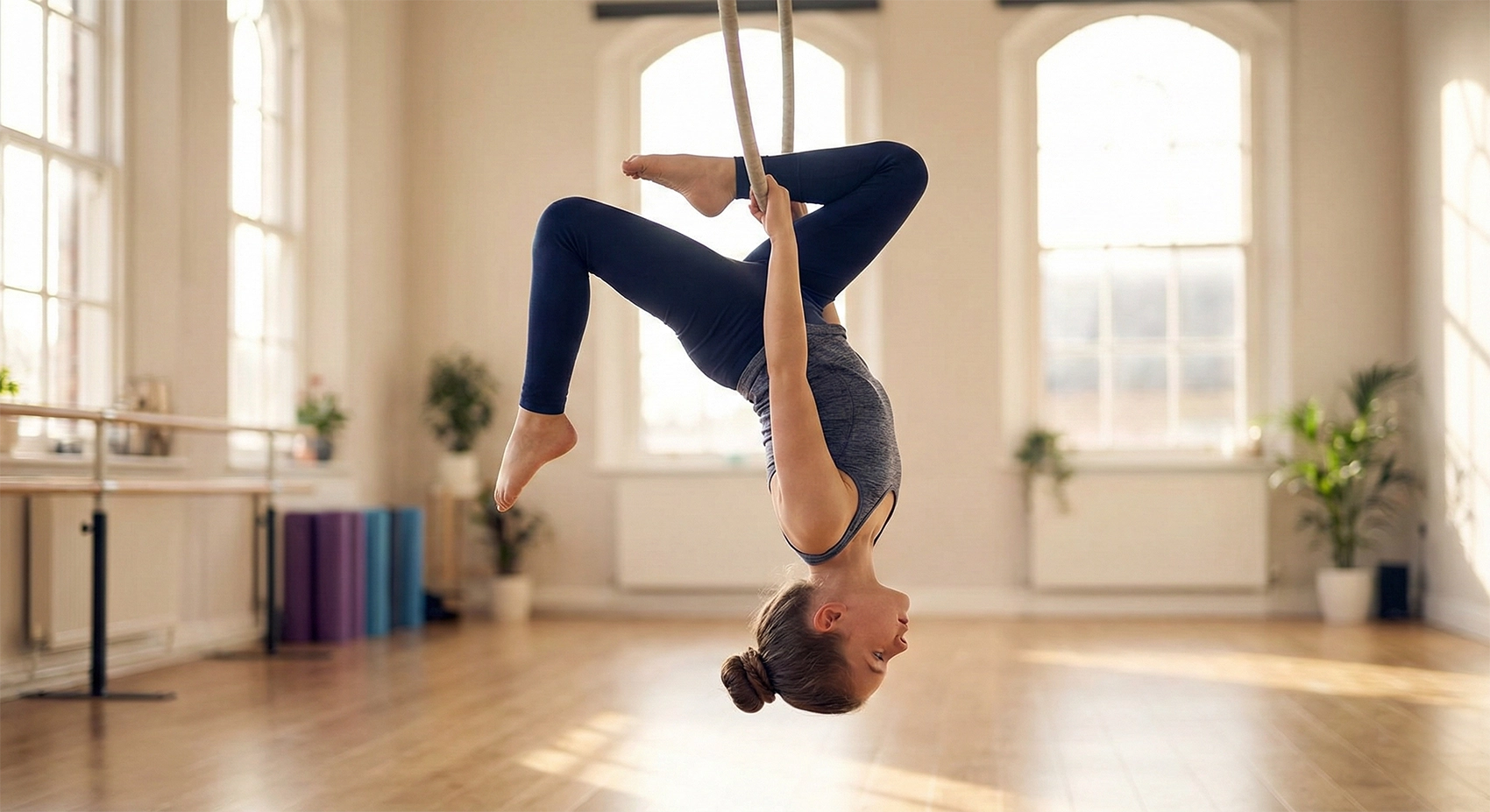
Aerial Hoop, homework routines, focus, resilience, executive function
Five ways aerial hoop helps with homework
This report explores how aerial hoop, also known as Lyra, can support cognitive development and make homework time calmer and more productive for families in Kent, with a focus on Artists in Motion School of Dance in Aylesham.
- For parents in Kent
- Cognition and movement
- Practical homework tips
- Aerial hoop and focus
Contents
- Part I, Context, the homework battle and the sedentary crisis
- Part II, the neuroscience of movement and learning
- Part III, Way 1, vestibular regulation
- Part IV, Way 2, working memory and sequencing
- Part V, Way 3, resilience and growth mindset
- Part VI, Way 4, proprioceptive focus
- Part VII, Way 5, cognitive flexibility
- Part VIII, the Artists in Motion ecosystem
- Part IX, aerial arts for ADHD and neurodiversity
- Part X, practical guide for Kent parents
- References
Key takeaways
- Vestibular regulation, calming the fidgets to enable stillness.
- Working memory enhancement, using choreographic sequencing to improve mental retention.
- Cognitive flexibility, developing problem solving skills through spatial adaptation.
- Emotional resilience, building grit and growth mindset through controlled risk.
- Proprioceptive focus, using heavy muscle work to ground the nervous system.
The intersection of physical activity and academic performance is a well trodden path in educational psychology, yet the specific contributions of complex, three dimensional movement arts remain under explored in mainstream parenting discourse.
This report aims to bridge that gap for parents in Kent, specifically examining how Aerial Hoop, also known as Lyra, a core discipline at Artists in Motion School of Dance, AIM, in Aylesham, serves as a potent catalyst for cognitive development and academic efficiency.
In the current educational landscape of the United Kingdom, children face increasing academic pressures, with homework often becoming a flashpoint for family stress. Recent data indicates that a significant proportion of primary school children in the UK are spending upwards of five hours a week on homework, with many parents feeling the pressure is excessive.[1]
Concurrently, the rise of sedentary behaviour and screen time has created a movement deficit that impairs the developing brain’s ability to regulate attention and process information.[2]
This report posits that aerial hoop is not merely an extracurricular hobby but a neuro developmental intervention. By engaging the vestibular system through inversion and rotation, stimulating proprioception through heavy work, and demanding high level executive function for sequencing and safety, aerial arts prepare the brain for the rigours of the classroom.
Drawing on extensive research into embodied cognition, occupational therapy, and sports psychology, alongside the specific pedagogical framework of Artists in Motion, this document outlines five evidence based mechanisms through which aerial training enhances homework performance.
Example: If homework time regularly starts with fidgeting, frustration, and tears, the issue is often regulation, not intelligence. The right type of movement can help a child arrive at homework in a calmer, more ready state.
Part I, the context, the homework battle and the sedentary crisis
1.1 The landscape of homework stress in Kent
For many families across Kent, the hours between school pickup and bedtime are fraught with tension. The transition from the structured environment of the classroom to the home environment often results in what experts call restraint collapse, where a child, having held it together all day, releases their pent up energy and frustration just as the homework books come out.
The academic burden
The pressure on children aged 6 to 16 has intensified. Independent surveys of UK parents reveal a stark picture.
- Volume of work: More than one in ten primary school children spend five hours or more on homework each week.[1]
- Parental anxiety: Two in five parents of primary school children believe their children are under too much pressure to perform, a sentiment that statistically mirrors the stress levels of parents with teenagers sitting GCSEs.[1]
- Household friction: Homework is frequently cited as a primary source of arguments in the home, often displacing valuable family downtime or sleep.[3]
In Northern Ireland and parts of the UK, the average homework load can reach 6.3 hours a week for older primary students.[4]
While the educational efficacy of homework for primary students is debated, with the Education Endowment Foundation noting a modest impact of plus 3 months progress in primary versus plus 5 months in secondary, it remains a reality of school life.[5]
The biological mismatch
The core issue is often a biological mismatch. Evolutionarily, children are designed to move. The modern requirement to sit still for six hours at school, followed by another hour at the kitchen table, fights against their physiological needs.
- Sedentary statistics: Research indicates that more than half of a child’s waking hours are spent in non active states.[2]
- The consequence: When the body is stationary for too long, the brain struggles to maintain arousal levels, alertness. To compensate, the child’s nervous system may resort to sensory seeking behaviours, fidgeting, rocking, or emotional outbursts, to wake itself up. This is often misdiagnosed as disobedience or lack of focus, when in reality, it is a physiological cry for vestibular input.
1.2 The Artists in Motion solution, skills for life
Situated in Intex House, Aylesham, Artists in Motion School of Dance, AIM, offers a counter narrative to the sedentary crisis. Their philosophy extends beyond teaching dance steps, it focuses on creating artists, not just dancers, by instilling skills that serve the child outside the studio.[6]
The philosophy of AIM
The school’s mission statement is encapsulated in the acronym AIM.
- ACHIEVE: Helping every student reach their dreams.
- INSPIRE: Fostering a lifelong passion.
- MAKE: Creating a positive difference in every child’s life.[7]
This pedagogical approach is rooted in core values such as growth, determination, and commitment. The school explicitly states, we believe that by staying determined and prepared, each dancer can grow in confidence, skill, and self belief. With commitment, every student learns the value of hard work.[6]
These are not just athletic values, they are academic ones. The resilience required to master a skin the cat on the hoop is the same resilience required to master long division.
The Aerial Academy
AIM’s Aerial Academy is distinct from its general dance classes. It fuses artistry with athleticism, using suspended equipment, hoops, Lyra, to build core strength and confidence.[8]
Unlike a football pitch or a running track, the aerial environment is three dimensional. It requires the child to navigate gravity, manage dynamic forces, and perform complex sequences while suspended. This report argues that this specific type of complex motor activity is uniquely suited to priming the brain for cognitive tasks.
Part II, the neuroscience of movement and learning
2.1 Embodied cognition, the brain body loop
For decades, educators treated the mind and body as separate entities, the body went to PE, and the mind went to Maths. However, the theory of embodied cognition argues that cognitive processes are deeply rooted in the body’s interactions with the world.[9]
The cerebellum prefrontal connection
The cerebellum is the part of the brain responsible for coordination, precision, and accurate timing. The prefrontal cortex, PFC, is the CEO of the brain, responsible for executive functions, EF, like planning, working memory, and inhibition.
- The link: Neuroimaging studies have shown robust neural pathways connecting the cerebellum and the PFC. When a child engages in a complex motor task, like stabilising themselves on a spinning hoop, both areas light up simultaneously.[10]
- Co development: Research confirms that motor competence and executive functions co develop. A study of Chinese children found a significant correlation between fundamental motor skills and executive function, suggesting that targeted motor interventions can drive cognitive growth.[10]
2.2 Complexity matters, the dual challenge
Not all movement is created equal. While running, a repetitive, aerobic activity, is good for general blood flow, complex motor schemes are superior for cognitive development.
- Definition: Complex motor schemes are coordinated sequences of movements that demand planning, sequencing, and adaptation in real time.[12]
- The aerial advantage: Aerial hoop is a quintessential complex motor activity. It is never purely repetitive. A student must constantly adjust their grip, centre of gravity, and limb position based on the swing of the hoop. This creates a dual challenge context where the child is managing physiological stress, holding their weight, and cognitive load, planning the next move, simultaneously.[12]
2.3 BDNF, fertiliser for the brain
Physical activity triggers the release of brain derived neurotrophic factor, BDNF, a protein that supports the survival of existing neurons and encourages the growth of new synapses and neurons, neurogenesis and synaptogenesis.[12]
- Mechanism: BDNF is particularly active in the hippocampus, memory, and the prefrontal cortex.
- Timing: The effects of BDNF are most potent immediately following exercise. This suggests that the window of time after an aerial class is a golden hour for cognitive tasks, as the brain is chemically primed to learn.[14]
Part III, Way 1, vestibular regulation, the key to sitting still
3.1 Understanding the vestibular system
Located in the inner ear, the vestibular system is the body’s internal GPS. It consists of the semicircular canals, which detect rotation, and the otolith organs, which detect linear movement and gravity.[15]
It is the first sensory system to develop in utero and is critical for:
- Balance and posture: Keeping the body upright against gravity.
- Visual stabilisation: Keeping eyes focused on a line of text while the head moves.
- Arousal regulation: Determining whether we are alert, sleepy, or hyperactive.
3.2 The link to attention
The vestibular system has direct neural connections to the reticular activating system, RAS, in the brainstem. The RAS acts as a volume dial for the brain, controlling alertness.[15]
- The problem: Many children have a vestibular system that is either under sensitive, needing huge amounts of movement to feel awake, or over sensitive, feeling dizzy or anxious easily.
- The homework symptom: A child who craves vestibular input cannot sit still. They will tip their chair back, shake their legs, or jump around. They are not being naughty, they are self medicating to keep their brain awake.
3.3 How aerial hoop regulates the system
Aerial hoop offers a sensory diet that is difficult to replicate in a standard classroom or playground.
Inversion, the power of upside down
Hanging upside down is a defining feature of aerial arts.
- Mechanism: Inversion stimulates the otolith organs intensely. It increases cerebral blood pressure momentarily, triggering baroreceptors that eventually signal the parasympathetic nervous system, the calm system, to engage.[18]
- Benefit: For a sensory seeking child, a few minutes of inversion can fill the sensory bucket for hours. It provides the intense input the brain craves, allowing the child to return to a state of equilibrium where sitting still is physiologically possible.[19]
- Research: Studies suggest that vestibular stimulation can reduce anxiety and improve emotional regulation, creating a better internal environment for focus.[21]
Rotation, spinning
Aerial hoops are often rigged on swivels, allowing them to spin.
- Mechanism: Rotation stimulates the fluid in the semicircular canals.
- Benefit: While fast spinning is alerting, good for waking up a sleepy child, slow, linear swinging or gentle rotation is deeply organising and calming. It helps synchronise neural firing in the brain, which can improve focus and attention span.[23]
3.4 Transfer to homework
When a child returns from an AIM class, their vestibular needs have been met. The static created by the need to move has been quieted.
- Outcome: The child can sit at a desk without the constant urge to move. Their posture is better supported, due to vestibular core connection, meaning they fatigue less quickly while writing.
- Parental tip: If a child is struggling to focus on homework, a vestibular break, like hanging off the sofa or doing a handstand against the wall, can mimic the studio environment and reset their focus.[20]
Part IV, Way 2, working memory and sequencing, the choreography factor
4.1 The cognitive demand of aerial sequences
Homework often fails not because a child lacks intelligence, but because they lack working memory, the ability to hold information in mind while manipulating it.
In an aerial hoop class at AIM, students do not just play. They learn specific, named moves and sequences. For example, a beginner sequence might be Delilah Mount, Pike, Straddle, Dismount.
- Encoding: The student must watch the demonstration, visual encoding.
- Translation: They must map that visual information onto their own body, proprioceptive translation.
- Retention: They must hold the sequence in working memory while performing the physically demanding task of lifting their body weight.
4.2 Procedural memory and academic transfer
This process builds procedural memory, the memory of how to do things.
Research suggests that dance and movement training can improve working memory capacity. The mental effort required to recall a sequence of steps uses the same neural resources required to recall the steps of a long division problem or the structure of a sentence.[25]
Aerial arts are highly spatial. Students must visualise their body in 3D space, for example, if I hook this leg, which way do I face. This trains the visuospatial sketchpad component of working memory, which is directly correlated with mathematical ability, particularly in geometry and algebra.[9]
4.3 The dual task advantage
As students progress to intermediate levels, they are often asked to perform moves to music or while receiving verbal corrections.
- Mechanism: This is dual tasking, performing a motor task and a cognitive task simultaneously.
- Benefit: Research indicates that dual task training improves divided attention. In a classroom, a student must listen to the teacher while taking notes. Aerial training can prime the brain for multi channel processing.[12]
4.4 Application to homework
A child with stronger working memory can:
- Read a paragraph and remember the beginning by the time they reach the end.
- Perform mental maths without losing their place.
- Follow multi step instructions without needing reminders.
Aerial hoop provides a fun, high stakes arena to practice these skills. If you forget the sequence on the hoop, you get stuck. The feedback is immediate, reinforcing the importance of focus.
Part V, Way 3, resilience and growth mindset, the grit factor
5.1 The psychology of risky play
The emotional component of homework is often the hardest to manage. Tears over a difficult problem, the I cannot do it meltdown, and fear of failure are major barriers. Aerial hoop builds emotional resilience.
Aerial arts fall under the category of risky play, specifically play with great heights. Research associated with Dr Ellen Sandseter highlights that risky play is crucial for developing resilience. It allows children to flirt with fear in a controlled environment. They learn to distinguish between I am scared and I am unsafe.[27]
The 17 second rule, observation suggests giving children time to figure out a risk before intervening builds autonomy. At AIM, instructors spot the children but encourage them to find their own stability. This builds risk competence.[27]
5.2 Building self efficacy through micro failures
In aerial arts, failure is expected. No child walks into their first class and performs a perfect Russian Split. They will slip, they will struggle to pull up, and they will get things wrong.
Each class involves dozens of micro failures followed by eventual success. This cycle rewires the brain’s reward system. The dopamine hit comes after the struggle, teaching the child that effort leads to reward.
This aligns with Carol Dweck’s growth mindset work. The child learns that ability is not fixed, it is the result of practice. I cannot do it yet becomes the default internal monologue.[30]
5.3 Distress tolerance
When a child hangs from a hoop, their body experiences physiological arousal, increased heart rate, adrenaline. They must learn to stay calm and think clearly despite this physical stress.
Transfer: this becomes distress tolerance. When a child faces a stressful exam question, their body reacts with a similar stress response. The aerialist has trained their brain to say, I am stressed, but I can still think. I can find a grip. This can reduce exam anxiety and prevent choking under pressure.[32]
Example: A child who used to melt down at a tricky maths question may start saying, “Let me try again,” because they are used to practice, corrections, and trying one more time in the studio.
Part VI, Way 4, proprioceptive focus, grounding the nervous system
6.1 Heavy work and alpha waves
Proprioception is the body’s ability to sense its position, movement, and force. It is often referred to as the heavy work sense because it is activated by compression and traction, pushing and pulling, of the muscles and joints.
Aerial hoop is a highly proprioceptive activity. It involves lifting body weight, traction on the shoulder joints, and pressing limbs against the metal bar, compression.[33]
Heavy work is associated with neurotransmitter activity linked to mood regulation and focus. It can shift the brain from a high frequency beta state, scattered, anxious, to a lower frequency alpha state, calm, focused alertness.[34]
For children who feel floaty, anxious, or disconnected, common in ADHD profiles, the intense physical feedback of the hoop can act like an anchor. It tells the brain exactly where the body is, which can provide a sense of safety and grounding.[36]
6.2 Grip strength and academic correlation
There is a body of research linking fine motor skills and grip strength to academic performance.
- Handwriting: The stamina required to write an essay depends on proximal stability, shoulder and core strength. Aerial hoop builds upper body and core stability, which can support handwriting endurance and legibility.[38]
- Maths connection: Studies have shown a correlation between fine motor integration and mathematical ability in primary school children. The neural networks used to manipulate objects with the hands are closely linked to those used to manipulate numbers mentally.[9]
6.3 Application to homework
After a session of heavy work at AIM, a child is often in a more regulated state. This creates a window of 1 to 2 hours post exercise where the child is calmer, grounded, and able to focus. This can be a strong time to tackle the most challenging homework tasks, rather than forcing homework immediately after school when they are sensory depleted.
Part VII, Way 5, cognitive flexibility, the antidote to rigid thinking
7.1 Spatial problem solving
Cognitive flexibility is the ability to switch gears, to move from one concept to another, or to change strategies when a current approach is not working.
In aerial arts, the environment is constantly changing. A student might be right side up one moment and upside down the next. The brain must constantly recalculate its coordinates. Left and right change meaning depending on orientation. This forces the brain to be flexible.
Aerial arts involve open skills, movements that must adapt to a changing environment, such as a spinning hoop, as opposed to closed skills like running on a track. Research suggests open skill activities can be particularly beneficial for cognitive flexibility.[41]
7.2 Improvisation and adaptation
As students advance to higher levels at AIM, they are encouraged to improvise or adapt routines.
If a student attempts a move and gets their leg stuck, they cannot simply stop, they must problem solve their way out in mid air. This can train divergent thinking, the ability to generate multiple solutions to a problem. In homework, a rigid thinker gives up if their first attempt fails. A flexible thinker tries a different approach.[42]
Part VIII, the Artists in Motion ecosystem, why environment matters
8.1 The AIM structure, a framework for discipline
While the mechanics of aerial hoop are beneficial, the environment in which they are taught is critical. A home rig without supervision does not provide the same cognitive benefits and can pose significant risks compared to the structured curriculum at Artists in Motion.
AIM operates on a structured level system, intro to level 5, aligned with professional standards from the Imperial Society of Teachers of Dancing, ISTD, and Acrobatic Arts.[44]
AIM class levels and homework skill transfer
| AIM class level | Key skill focus | Cognitive transfer to homework |
|---|---|---|
| Tiny Tumblers, age 3 | Basic rolling, balancing | Vestibular, early reading readiness, tracking |
| Kinder Acro, age 4 to 5 | Coordination, following instructions | Executive function, learning to listen and execute |
| Beginner, fundamental | Grip strength, basic mounts | Proprioception, handwriting stamina and focus |
| Levels 1 to 3 | Sequencing, memory | Working memory, multi step problem solving |
| Levels 4 to 5 | Dynamic drops, flow | Resilience, exam stress management |
Tiny Tumblers, age 3
Key skill focus: Basic rolling, balancing
Cognitive transfer: Vestibular, early reading readiness, tracking
Kinder Acro, age 4 to 5
Key skill focus: Coordination, following instructions
Cognitive transfer: Executive function, learning to listen and execute
Beginner, fundamental
Key skill focus: Grip strength, basic mounts
Cognitive transfer: Proprioception, handwriting stamina and focus
Levels 1 to 3
Key skill focus: Sequencing, memory
Cognitive transfer: Working memory, multi step problem solving
Levels 4 to 5
Key skill focus: Dynamic drops, flow
Cognitive transfer: Resilience, exam stress management
8.2 The buddy system and social cognition
AIM employs a buddy system where new children are partnered with a peer for their first 3 to 4 weeks.[6]
Learning by watching a peer can activate mirror neuron systems, supporting social cognition and learning how to learn from others. By fostering compassion and friendship, core values, AIM can reduce social anxiety. A child who feels socially safe is a child whose brain is freer to learn. Social isolation is a stressor that can impair cognitive function, and a positive studio community can provide a buffer.[6]
8.3 Safety as a cognitive enabler
AIM’s safety protocols are not only about preventing injury, they also support psychological safety.
- Rigging: The studio uses professional rigging with a 10 to 1 safety factor.[47]
- No home rigs stance: AIM discourages home rigging because dynamic load during drops can be several times body weight, which can compromise ceilings and fixtures.[47]
- Cognitive impact: By keeping aerial arts in the studio, AIM creates a focused space. The child learns that this high focus state happens here, which can support switching into focus mode when they arrive.
Part IX, special focus, aerial arts for ADHD and neurodiversity
9.1 The dopamine connection
For parents of children with ADHD, autism, ASD, or sensory processing disorder, SPD, homework can be an intense struggle. Aerial hoop is increasingly recognised as a useful tool for neurodiverse profiles.
ADHD is often described as a regulation pattern involving dopamine. The ADHD brain can feel under stimulated and seeks stimulation. The combination of height, spinning, vestibular, and heavy muscle usage, proprioception, can provide a strong, natural stimulation effect. The child is moving because it is interesting and engaging, not because they were told to. This can make it easier to sustain attention for a full class, which can help strengthen attention habits over time.[36]
Many children with ADHD struggle to focus on boring tasks but can hyperfocus on things that interest them. Aerial hoop can harness that hyperfocus and train the child to sustain it. This attention muscle can then be supported and encouraged in other areas.[49]
9.2 Sensory integration therapy parallels
Aerial training can overlap with principles used in occupational therapy settings.
In aerial sling or hammock classes, fabric can wrap around the child, providing deep pressure. This can be similar to the calming mechanism of a weighted blanket, supporting a calmer nervous system response during frustration.[37]
Moves that require crossing the midline, for example reaching the right hand to the left side of the hoop, support bilateral coordination. This integration is relevant for reading, tracking across a page, and writing.[49]
Example: If your child needs movement to think, forcing stillness can backfire. A structured, supervised hour of the right kind of movement can help them come back to homework calmer and more ready.
Part X, practical guide for Kent parents
10.1 The after school decompression protocol
Stop trying to force homework immediately after school. The child’s cognitive battery is often flat.
The routine:
- 3:30 pm, school pickup
- 4:00 pm, snack, protein and carbohydrate mix
- 5:00 pm, AIM aerial class, the reset
- 6:30 pm, dinner
- 7:00 pm, homework window
Why: post class, the child may have higher BDNF activity, a more regulated vestibular system, and fewer wiggles. You may get more done in 30 minutes at 7:00 pm than in 2 hours of friction at 4:00 pm.[50]
10.2 Micro movements for homework breaks
You cannot hang a hoop in the lounge, but you can use the principles of aerial arts during homework breaks.
- Inversion break: If they are stuck on a maths problem, have them hang their head off the sofa for 30 seconds. The blood flow change can help reset attention.[20]
- Heavy work break: Wall push ups, or carrying a small stack of books. Proprioceptive input can help re ground focus.[24]
10.3 Sleep hygiene
Aerial arts can be physically tiring. This can be useful.
Sleep is when the brain consolidates memory, moving learning into longer term storage. Research suggests vigorous physical activity can improve sleep efficiency.[51]
Strategy: on aerial nights, keep bedtime consistent. Physical fatigue can help them fall asleep sooner, improving the chance that the homework done earlier is retained.[52]
Interested in trying aerial hoop?
Artists In Motion School of Dance is based at AIM Studios, Intex House, Cooting Road, Aylesham, CT3 3EP, Kent. For class information, call +44 7974 930 845 or email jessica@artistsinmotion.co.uk.